
BY Mairead Healy
Everytime you walk around the streets outside, you are adding to the social structure of our world. You might feel the sun shining in your eyes, the rain soaking through your jacket, hell, you might even face a fearsome attack from an artsblock seagull. This mosaic of experiences is what makes up our complex world, full of social interactions between our biotic and abiotic environment.
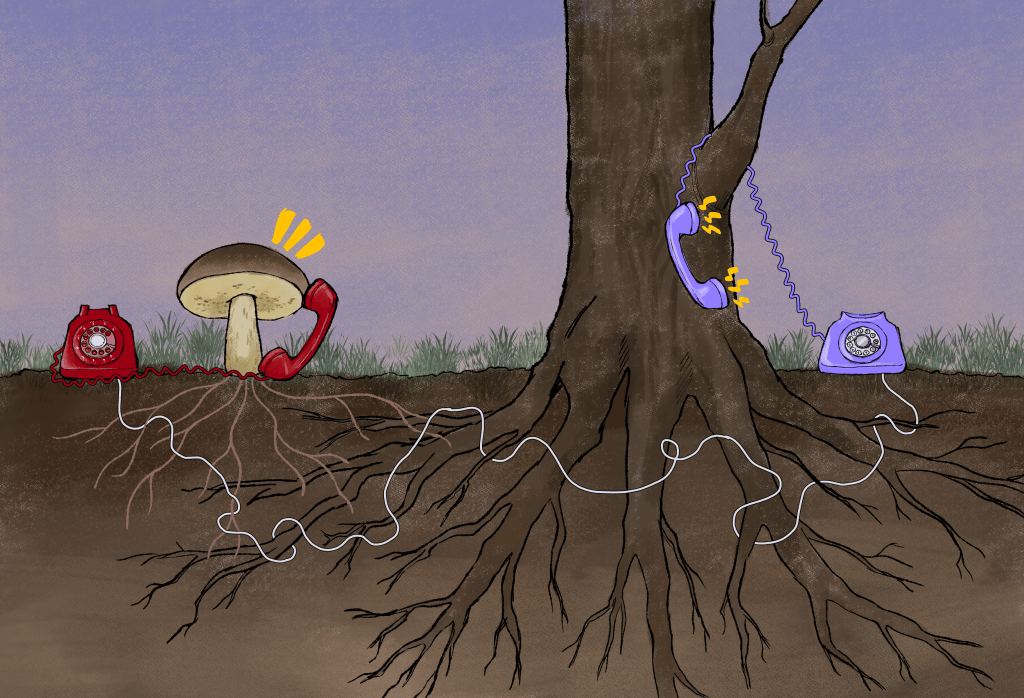
“Tree roots make a multitude of connections with mycelial networks underground, forming mycorrhizae and opening up an environmental information exchange”
What if I told you that the complex world above ground, has an equally complex world below. This is the social underworld of trees, known more amusingly as the Wood Wide Web. Much like you and your ex-situationship, trees also form lasting, complicated relationships. This subterranean society is composed of all rooting plant species as well as microbes, nutrients, waste chemicals, and even fungi!
When you think fungi, you think mushroom! In reality, the mushroom is just a tiny fraction of the entire fungal system, which lives in 3D space within the subterrane. Fungi are heterotrophic eukaryotic organisms. They can’t photosynthesize due to their lack of chlorophyll, and they aren’t large enough to hunt animal prey so they must live amongst their chemical food sources, “hunting” and digesting it through symbiotic relationships.
Fungi build vast underground webs of tiny thread-like structures called hyphae, with compiling networks forming mycelium. This acts as an invisible extension of various plant root systems, creating a connecting channel between distal root communities from neighbouring plant species. Depending on the type of fungi, they can wrap around the outside tips of plant roots (ectomycorrhizal fungi), or the fungi can fully penetrate the cell wall of plant roots to create specialized arbuscular structures known as endomycorrhizal fungi. This merger between fungi mycelia and plant roots is known as the mycorrhizae – making the “wires” that form the Wood Wide Web.
Tree roots make a multitude of connections with mycelial networks underground, forming mycorrhizae and opening up an environmental information exchange. The fungi have a constant source of nutrients in the form of tree waste chemicals excluded out of their roots, and the trees can use this interconnected network, by which all their communication is facilitated. Vital information about their environment, stress levels, community abundance, and spatial orientation is freely shared within the symbiotic relationship.
These buried networks can span acres, acting as a vital tool in supporting healthy forests. Trees can use this network to receive chemical messages about the health of their neighbours, drought, or pass warnings about nearby disease. Neighbouring trees can respond accordingly, by producing protective enzymes or bitter tannins as a deterring defence. More altruistically, older trees within the network can choose to send extra nutrients and water to nearby samplings or struggling trees, helping nurture the next generation of their natural village. Most notably, dying trees within the network will shuttle their remaining resources and biochemical warning signals through the wide underground network, as a final dumping of their life force into other trees.
As intricate and complex our own lives may feel, there is a more tangled and elaborate network of life found just below our feet. So next time you say hi to a friend, buy someone a coffee, or feed the local seagulls (willingly or not!), remember that through their relationship with fungi, trees are in a way able to do the same thing.


Leave a Reply