
BY Michael Glynn
Since its discovery by Isaac Newton centuries ago, gravity has been thought of as an invisible force of attraction between massive objects. This idea was critically challenged in 1915, when Albert Einstein first proposed General Relativity. Instead of acting as a force, he explained gravity as a curving of space-time around massive objects, with other objects travelling along these curves. Einstein also used his theory of General Relativity to predict ripples in space-time could be caused by the acceleration of masses through space. These ripples had already been theorised in 1905 by French mathematician Henri Poincaré, who named them “Gravitational Waves”.
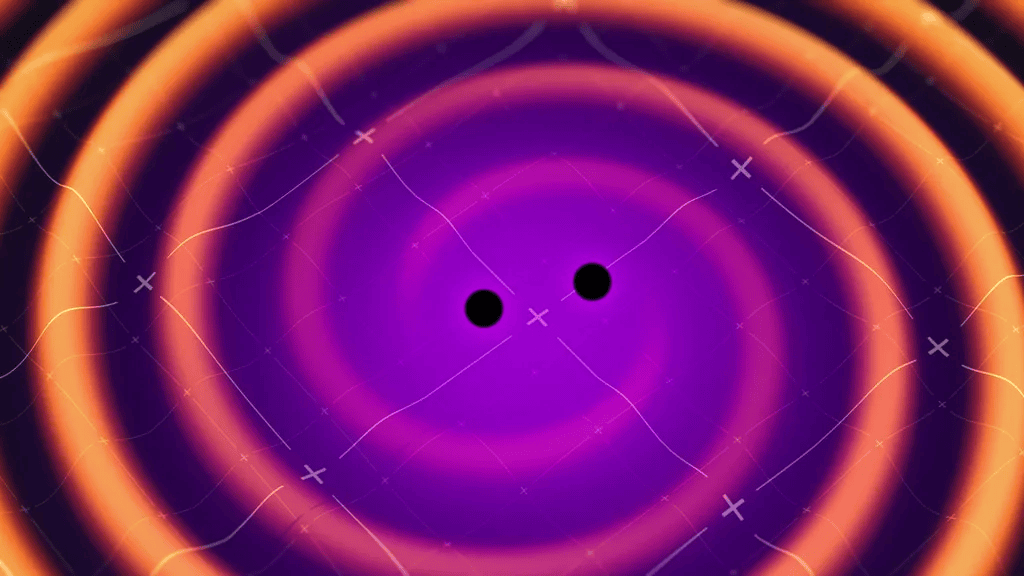
Though Einstein theorised their existence, he was unsure whether they would ever be detected. This is because they lose energy quickly as they move away from their source, meaning they would become very weak by the time they reach Earth. However, in the 1970s, observations of a binary pulsar system led to the indirect detection of gravitational waves. Russell Hulse and Joseph Taylor measured the orbital decay of this system, showing the pulsars were losing energy at the rate they would if the theorised gravitational waves were emitted by the system. They went on to be awarded the Nobel Prize in 1993 for this discovery.
In order to measure gravitational waves directly, physicists had to come up with a way to measure incredibly small changes in distance, as the squeezing and stretching of space-time caused by gravitational waves is nearly undetectably small. This led to the development of one of the most advanced technologies in modern astrophysics; laser interferometry.
After many failed attempts, the first direct observation of a gravitational wave was eventually made in 2015 at the Laser Interferometry Gravitational-wave Observatory (LIGO). This instrument consists of two 4km long perpendicular arms, which when a gravitational wave passes, will microscopically extend one arm, while compressing the other. This produces an interference pattern as the lasers in each arm are stretched in and out of phase with each other. This interference pattern allows us to measure the properties of passing gravitational waves.
Since their first direct observation, gravitational waves have allowed us to better investigate astrophysical objects which emit little to no electromagnetic waves, such as black holes and neutron star collisions. The future of this field is promising, as scientists and engineers continue to improve the sensitivity of existing interferometers, while also making plans for new detectors. One such detector is the proposed Laser Interferometry Space Antenna (LISA), which will consist of three satellites, millions of kilometres apart, firing lasers at each other. This will allow us to detect lower frequency gravitational waves than we can detect on Earth, meaning we will be able to study black holes in greater depth than previously possible.
Now, over a century after they were first theorised, we have not only proven the existence of gravitational waves but have directly measured hundreds of them. What was once an abstract hypothesis has grown to be an irreplaceable part of modern astrophysics, deepening our understanding of space and the cosmos.


Leave a Reply