
Botanical Chameleons: Uncovering Hydrangea Hues
BY Perin winders
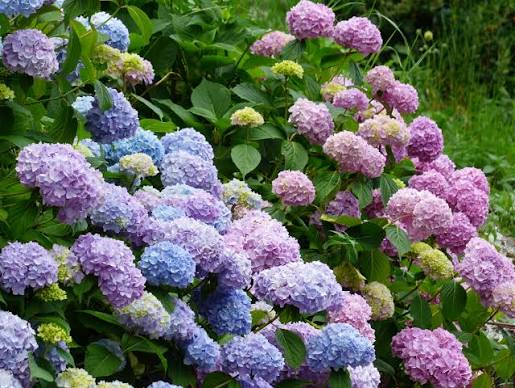
Sun-loving, bright-blooming – who doesn’t love a hydrangea? These mopheads come in a range of colours. A Hydrangea macrophylla bush in one garden might sport a striking blue, while the same species dons pastel pink petals next door. And all of this is just chemistry!
Soil acidity is influenced by aluminium availability. As the acidity increases, this lightweight metal is released from clay-bound particles and absorbed by the roots.
It gets transported to the petals where it stabilises an anthocyanin pigment complex, resulting in the blue hue of this high-acidity soil resident. In slightly acidic or slightly alkaline soil, the plant displays red or pink flowers.
Achieving these colours also relies on an inherent genetic capability, making these botanical chameleons a true wonder of nature.
IceCube Neutrinos: Measuring the (Near) Undetectable
By Aoibheann Maguire
Buried under 2500m of Antarctic ice lies the IceCube Neutrino Observatory, studying the trillions of “ghost particles” that pass through our body every second. Neutrinos are the most abundant particles with mass in the universe, but almost impossible to track as they rarely interact with matter. Lacking charge, they are produced when other elements change identities, like during radioactive decay.
They are undetectable by waves and are observed by specialised detectors equipped with light sensors embedded deep in the Antarctic ice so that they aren’t affected by cosmic rays at the surface. That’s how this year’s Nobel prize winner in physics, Frances Halzen, managed to turn ice into a telescope that could track extraterrestrial neutrinos, potentially carrying information from black holes to help elucidate how matter in our universe was formed. They might even be able to detect events that light can’t reach!
1816 – The Summer That Never Came
By Anastasia Titova
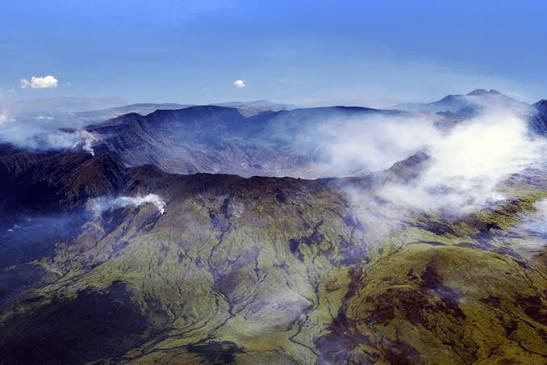
April 1815. An explosion happened, its consequences revealed only a year after. The summer of 1816 was not like any other, with Europe and North America reaching the lowest temperatures ever recorded as a result of the largest volcanic eruption in the last 10,000 years; Mount Tambora, Indonesia. Prior, ocean water was penetrating cracks in the volcano, reacting with magma, leading to the mountain exploding open and spewing 100 Km3 of gases, dust, and rock into the atmosphere, with ash particles entering the stratosphere, blocking solar radiation and absorbing heat. Along with an already volcanically active past few years, this led to a volcanic winter, dropping the global temperatures by 3°C, which lingered into the 1810s and has been noted as the coldest decade on record! Crops were destroyed across an already struggling Europe, recovering from the Napoleonic wars, and consequent increase in food prices worldwide led to the most violent riots since the French Revolution!
References:
Botanical Chameleons: Uncovering Hydrangea Hues
https://www.researchgate.net/publication/335925028_HOW_ARE_HYDRANGEA_FLOWE
R_COLORS_DETERMINED
https://hydrangea.com/blogs/growing-tips/the-straight-facts-on-hydrangea-flower-color?srs
ltid=AU7gw4UHRW3IBonAJqB9z85ByB1nI72X0T10f8kBuDgYbowd10b4AwOM
IceCube Neutrino: Measuring the (Near) Undetectable
https://icecube.wisc.edu/science/icecube/
https://www.theguardian.com/science/2026/oct/06/nobel-prize-in-physics-francis-halzen-s
outh-pole-neutrinos-icecube-detector
https://www.nobelprize.org/prizes/physics/2026/press-release/
https://www.energy.gov/science/doe-explainsneutrinos
1816 – The Summer That Never Came


Leave a Reply