
By Nik O’Duffy
“If, indeed, the sub-atomic energy in the stars is being freely used to maintain their great furnaces, it seems to bring a little nearer to fulfilment our dream of controlling this latent power for the well-being of the human race – or for its suicide.” – Arthur Eddington 1920 in The Internal Constitution of the Stars
In 1920, Arthur Eddington proposed that stars fuse hydrogen into helium, releasing energy. This could explain how stars were able to produce all their heat and light, and how it is possible that they produce most of the elements in the universe. This process – later known as nuclear fusion – is driven by immense gravitational pressure and temperatures in the millions of degrees, forcing the nuclei close enough that they overcome their natural repulsion and fuse to form heavier elements.
In 1934, Enrico Fermi bombarded uranium with neutrons in an unsuccessful attempt to create heavier elements. Later work by Otto Hahn and Fritz Strassmann revealed that Fermi had likely unknowingly split the uranium into lighter elements such as barium. This process became known as nuclear fission. However, it was noted that the smaller elements’ mass didn’t add up to the mass of the starting element, meaning some mass had been lost in the fission reaction. Lise Meitner applied Einstein’s mass-energy equivalence, E = mc², to explain how this missing mass was converted into energy, then released as heat and radiation during fission. This is the power utilised by both nuclear reactors and bombs.
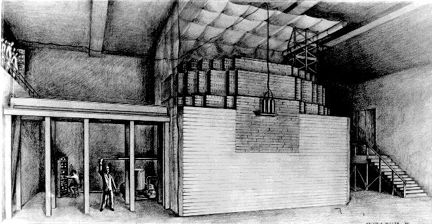
Soon the potential of using fission to produce vast amounts of energy was realised as physicists saw fission events were not only able to release energy but eject neutrons in the process, creating self-sustaining chain reactions. The first nuclear reactor, Chicago Pile-1, was built by Fermi’s team in 1942 in an abandoned squash court, described by Fermi himself as ‘a crude pile of black bricks and wooden timbers’. Nevertheless, this demonstrated that a fission chain reaction could be controlled to harness energy. Fission reactors are now a major low-carbon energy source, but they carry well-known risks: severe accidents, long-lived radioactive waste, and the potential to manufacture nuclear weapons.
Unlike fission, fusion remains difficult to achieve on Earth, requiring temperatures above 100 million degrees Celsius to sustain reactions. By the 1950s, Soviet scientists Andrei Sakharov and Igor Tamm helped conceptualise a machine for achieving fusion on Earth: the tokamak. Named after the Russian acronym for “toroidal chamber with magnetic coils,” it remains a leading candidate for fusion power. It generates a powerful magnetic field that confines a hot, electrically charged gas called plasma, allowing lighter nuclei to fuse and release energy. Fusion has yet to achieve plasma-heating energy breakeven, where the energy released equals the energy supplied to heat the plasma (Q = 1). The Joint European Torus (JET) achieved Q = 0.67 for about one second. A viable fusion power plant would require Q above 10, ideally substantially higher.
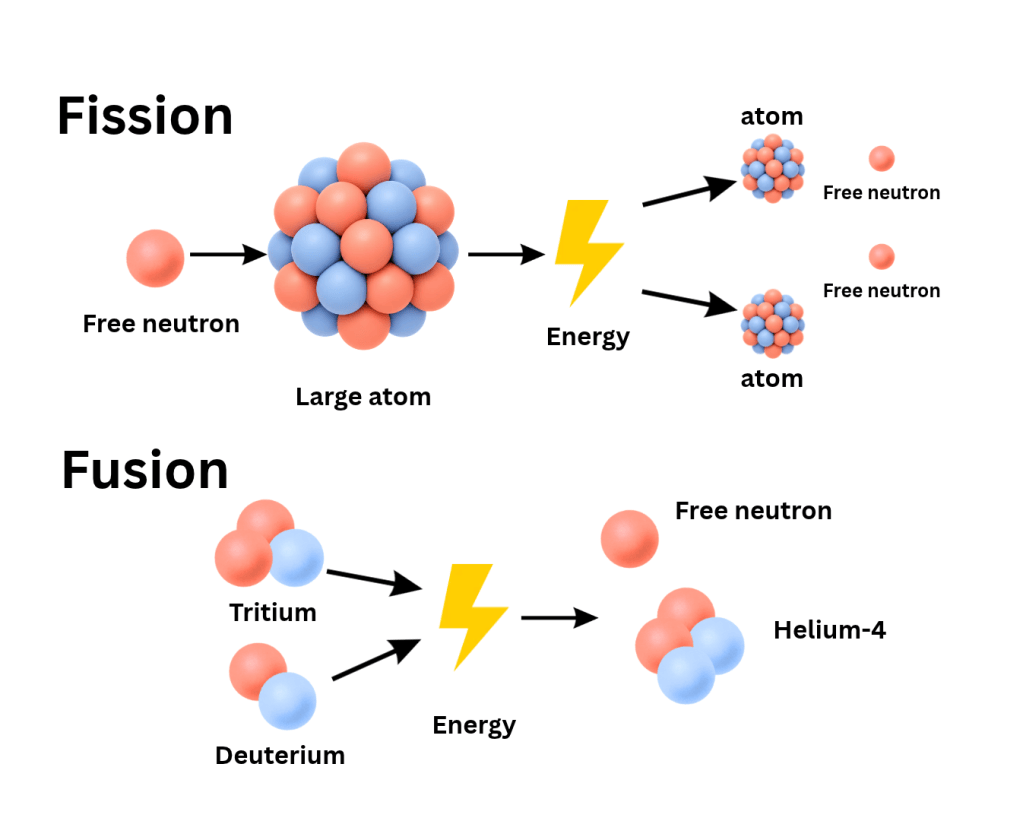
Fusion remains attractive as a potentially abundant energy source with no risk of meltdown and fewer long-lived radioactive waste products than conventional fission. In 1985, Soviet leader Mikhail Gorbachev proposed to US President Ronald Reagan an international collaboration to develop fusion for peaceful purposes: the International Thermonuclear Experimental Reactor (ITER). Under construction in southern France, ITER is designed to have six times the plasma volume of the current largest, Japan’s JT-60SA. It aims to produce ten times more energy than is supplied to heat the plasma (Q ≥ 10). ITER’s operations have been delayed to at least 2034, though it remains the most ambitious attempt to show that star-like power can be achieved on Earth.
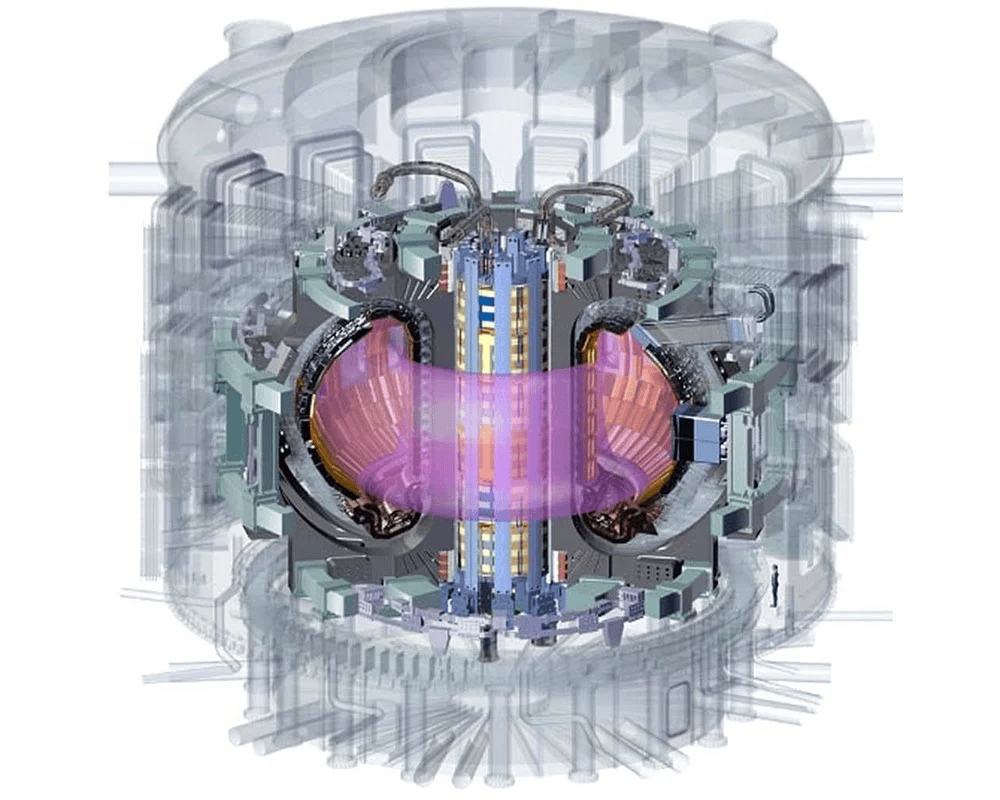
Credit © ITER Organizationhttps://www.iter.org/
With the threat of climate change and overdependence on fossil fuels, nuclear energy offers us a powerful way of producing energy. Shifting attitudes have renewed interest in nuclear fission reactors for our energy needs despite the fears over radioactive waste. Fusion promises abundant clean energy with fewer long-term hazards but remains out of reach. We can return to considering Eddington’s quote at the start, will nuclear energy be our future or our end?


Leave a Reply