
By Mairead Healy
The 2026 Nobel Prize in Physiology or Medicine was awarded to Karl Deisseroth (🇺🇸), Peter Hegemann (🇩🇪), and Georg Nagel (🇩🇪), for their work on light optogenetics– the manipulation of neurons with pulses of light!
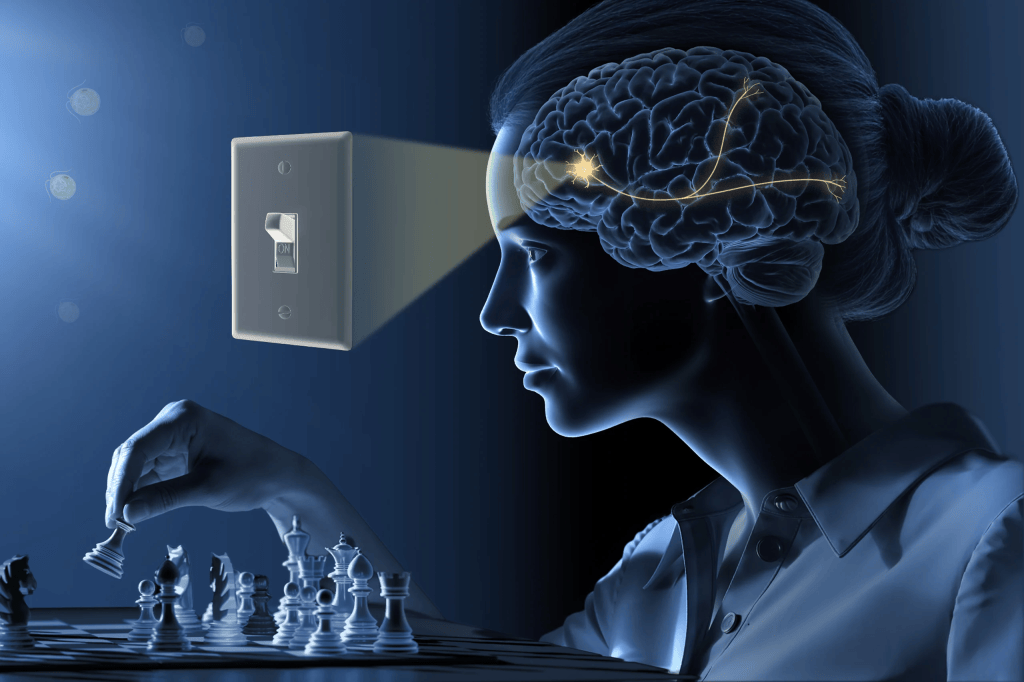
“for their discoveries concerning light-gated ion channels and optogenetics”
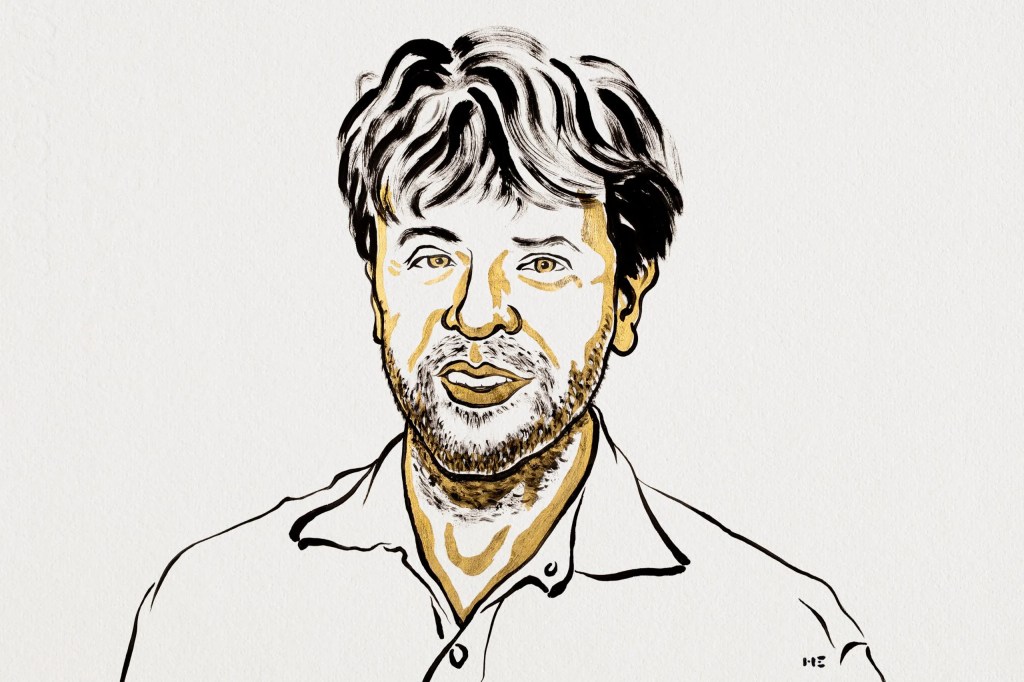
“for their discoveries concerning light-gated ion channels and optogenetics”
Niklas Elmehed © Nobel Prize Outreach

“for their discoveries concerning light-gated ion channels and optogenetics”
Niklas Elmehed © Nobel Prize Outreach

“for their discoveries concerning light-gated ion channels and optogenetics”
Niklas Elmehed © Nobel Prize Outreach
They discovered how to manipulate individual neurons within living mammalian brains, turning them on or off. This novel tool of optogenetics has changed the field of neuroscience!
It all started with Peter Hegemann, who spent his career researching the driving force behind single-celled algae called Chlamydomonas, moving towards light.
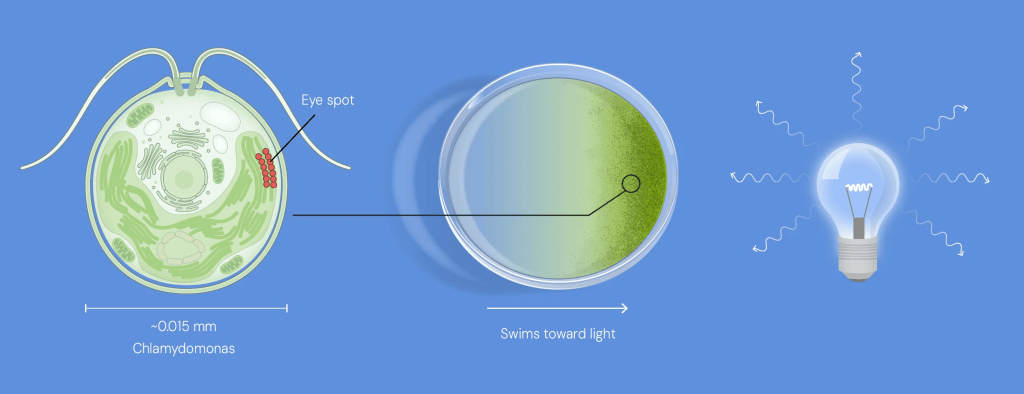
© The Nobel Committee for Physiology or Medicine.
With the collaboration of Georg Nagel, they discovered channelrhodopsin, a protein embedded in the plasma membrane of the algae that detected and responded to light. They sequenced the light-sensitive protein gene, inserted it into a frog embryo, and showed that it functions as a light-gated ion channel. That is to say, they proved that blue light illumination caused charged ions to flow into the cell, and an electrical impulse to occur. Regardless of which cell they put the protein in, it became responsive to light.
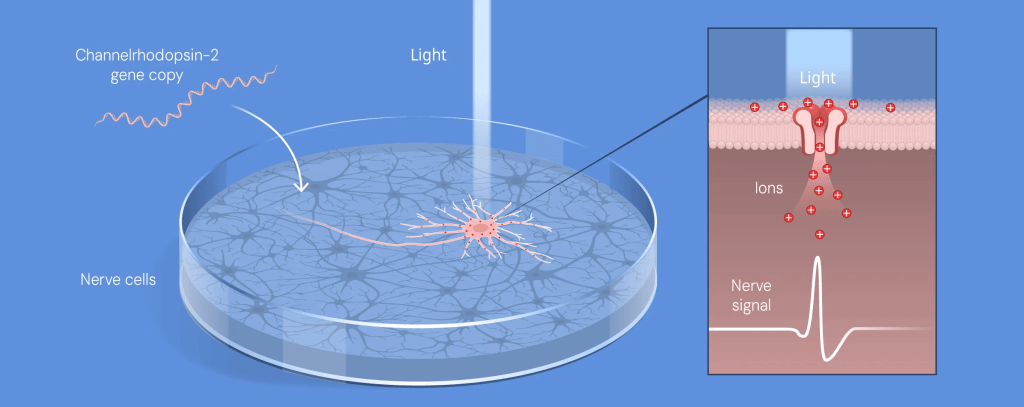
Furthering their research, Karl Deisseroth took a cognate mammalian copy of the light sensing protein gene (channelrhodopsin-2 gene copy), and inserted it into rat nerve cells, and later into the brain cells of living mice. His research showed that through optic fibre illumination, he could artificially create electrical signals within the light-stimulated cells. This method for controlling nerve signals with light is now called optogenetics.
In essence, optogenetics refers to the genetic editing or insertion of a light-sensing protein that responds with an electrical impulse, functioning across cell types. This new technique allows for individual nerve cells to be switched on and off, and has many promising clinical applications in the field of neuroscience, medicine, and psychiatry.
One main medical research use is the mapping of neuronal firing patterns, determining which neurons are active during specific pathologies, and creating brain maps. Optogenetic techniques could be used to determine neurons responsible for clinical psychiatric illnesses, by inhibiting or activating defective neurons causing illnesses such as depression or schizophrenia, and act as a novel treatment method. Karl Deisseroth believes that neurons can be identified as causational to specific psychiatric pathologies, and the use of light-triggered activation or inhibition of these neurons can act as a curative therapy.
Science starts with everyday people researching and collaborating on topics they find interesting! There are several promising applications of optogenetics, such as restoring vision, inhibiting seizures, or mitigating Parkinson’s Disease tremors. Think of all of the ways that atypical neuronal firing patterns cause pathologies. Can you think of any applications for this new light-sensing neuronal firing technique?


Leave a Reply