
By Derin Sariyel
When walking past a sweet shop or a bakery shelf of fruit pastries, you might notice a scent very similar to the one you smell when trying fruity perfumes in a perfume shop. This is because the same family of molecules is responsible for many distinct, often pleasant fruity aromas, and they are used across industries from food flavourings to fragrances. That family is esters.
Esters are organic compounds formed when a carboxylic acid reacts with an alcohol in a condensation reaction called esterification. In the classic acid-catalysed version, water is typically produced as a by-product. Aside from fragrance and flavour, esters are also important in the pharmaceutical, textile/dye, and plastics industries, though this article focuses on applications in fragrances and flavourings.
There are several synthetic routes for making esters, but there is growing demand for cleaner and greener production methods. Esters can also be produced via direct extraction from plants, but this approach is often hindered by high cost and by dependence on climate and agricultural conditions.
It is also important to note that chemical processes can produce molecules that are chemically identical to those found in nature, but depending on regulations, those products may not be allowed to be labelled as “natural.” On the consumer side, increasing demand for natural products, along with environmental concerns, is driving advances in greener ester production across industries, especially in flavour and fragrance manufacturing.
Lipase-based synthesis
One example of a shift towards greener chemistry in fragrance-ester production is a shift from traditional acid-catalysed esterification to biotechnology-based routes using enzymes, especially lipases. Lipases are enzymes that can help join an alcohol to an acyl group under milder and more sustainable conditions. Since lipases can often work without harsh reagents, sometimes in solvent-free systems, and with strong selectivity, they can reduce unwanted by products. Fewer by-products means less purification is needed later, reducing waste.
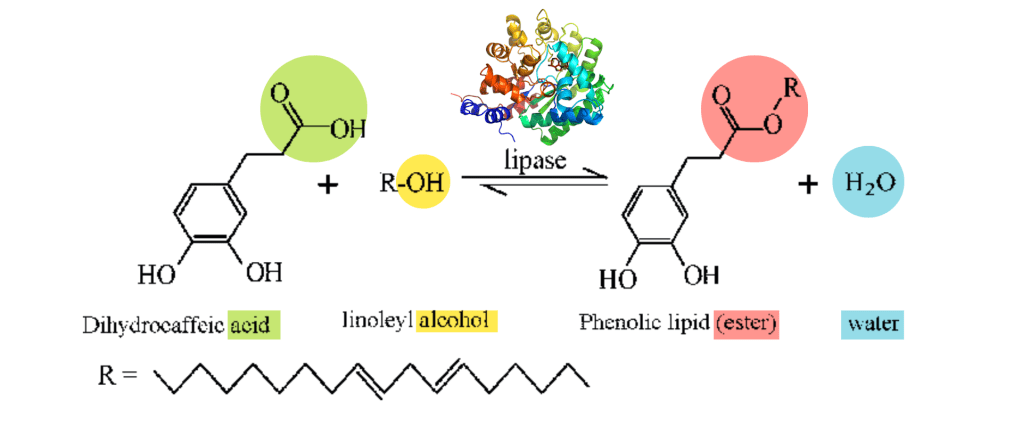
Modern processes increasingly use immobilized lipases (lipases fixed onto a solid support so they can be reused) and careful optimization of variables such as enzyme type, acyl donor, solvent, and temperature. This can enable high conversions for fragrance esters such as geranyl and citronellyl esters. These classes of esters appear frequently in perfumes because they can contribute rosy, citrusy, and peachy or pear-like notes, and they blend well with floral and citrus notes.
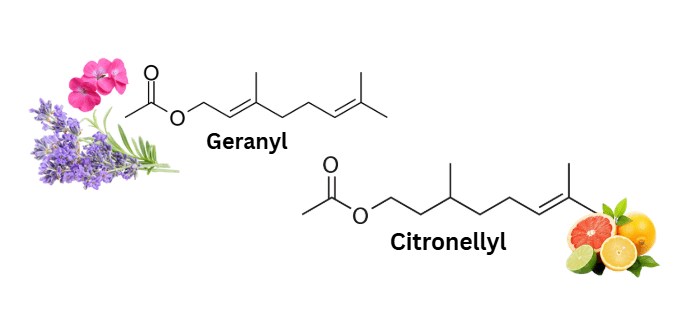
Notably, when enzymes and suitable natural feedstocks are used, products can qualify as “natural” under US and EU rules. That helps meet consumer demand for greener fragrance ingredients, not just through marketing, but through the actual production chemistry.
Precision fermentation
In the flavouring industry, precision fermentation is a widely used, well-established technique which offers a lower environmental footprint. The basic idea is to rewire metabolic pathways in microorganisms that are generally recognized as safe (GRAS) using precise genetic changes, then use fermentation scale-up and downstream processing to make edible ingredients from inexpensive starting materials. In this approach, flavour-active molecules, including esters, are produced in a fermenter, then purified from the fermentation broth. Depending on local rules, the use of genetic methods may or may not require special labelling on the final product.
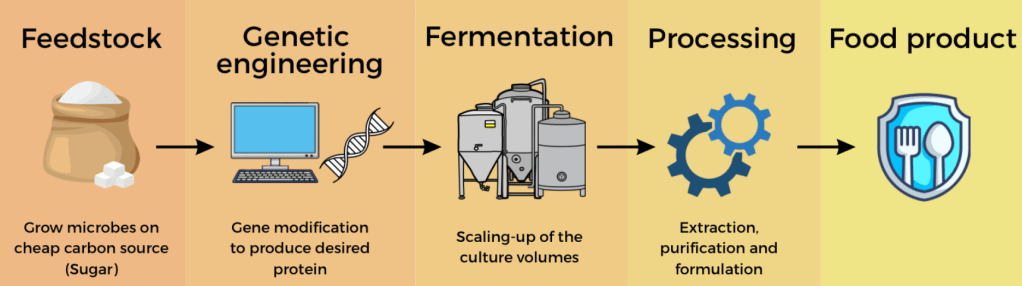
Precision fermentation can also be economically more viable than extracting the same molecules from plants, and it can be safer and more sustainable than chemical synthesis in some cases. One example of microbes being tuned to produce specific ester-driven aroma profiles is the engineering of Saccharomyces cerevisiae to increase ethyl acetate production. The goal of producing this compound is to help tune the flavour of fermented foods and beverages.
There are many ways to produce esters, and the route chosen depends on cost, sustainability, and the final use. Two examples were discussed in this article: lipase-based synthesis in fragrance chemistry, which is increasingly used as a newer biocatalytic alternative to harsher traditional methods, and precision fermentation in flavour production, a well-established approach that is now advancing rapidly through improved strain engineering and bioprocess design. Together, they show how the same family of molecules can link the smells we enjoy with some of the technologies used to make them.
 NeAr Science Magazine
Leave a comment