
By Elena kobaly
The malarial parasite, Plasmodium, exists in several infective forms, and has been a challenging target for drug development since its discovery in the late 19th century, due to its rapid life cycle and several life forms. Our immune system works by recognizing previously encountered patterns, however, this system fails once it meets Plasmodium; before it can release the appropriate response against one form, the parasite has already taken on another. How does one develop a vaccine against such a pathogen?
The infective form of Plasmodium exists in the form of a sporozoite, a short worm-like structure that resides in the saliva of a mosquito. This parasite is transferred into human blood through a mosquito bite. Sporozoites will travel through the bloodstream into liver cells, where they will begin to reproduce asexually into another form known as merozoites.
In the liver, the merozoites focus on building up their numbers. When a sporozoite enters a liver cell, it takes a little bit of the membrane with it, making a bubble-like vacuole around itself that prevents the host cell from recognizing it as a foreign substance. As such, the merozoites can grow in huge masses without interruption before they leave the liver and invade the bloodstream once again.
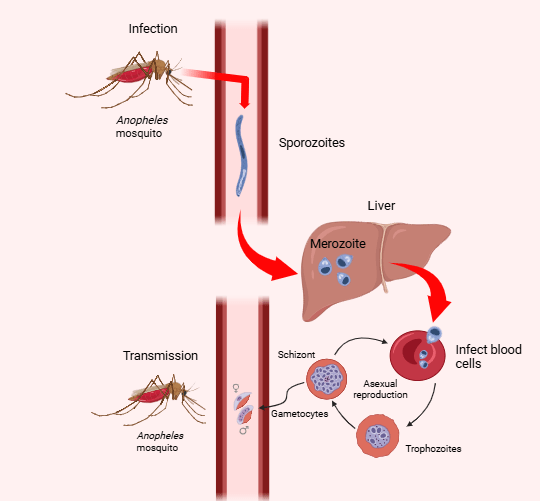
Back in the bloodstream, merozoites finally enter red blood cells, where they feed and grow into yet another two forms, trophozoites and schizonts, which go on to produce even more merozoites. The growth of these two new forms, alongside the production of merozoites causes the blood cells to break apart and permanently die. As such, red blood cells can no longer transport oxygen around the body efficiently.
Alternatively, the merozoites may become gametophytes, which will eventually produce sex cells that will be fertilized in the gut of another mosquito. Through this cycle of mosquito, to human, to mosquito, malaria is easily spread.
Mosquitoes are not affected by Plasmodium in the same way that humans are, given that the parasite never enters their blood cells. Instead, it uses their gut as a breeding ground. Following fertilization, the zygote will turn into an ookinete, yet another form which must penetrate a gut cell to be able to develop into an oocyst, a sac which will grow to produce the same infective sporozoites which began the cycle.
However, the mosquito is slightly ahead of us in terms of immunological response. It can recognize certain ookinetes as foreign and is able to kill the affected host cells through apoptosis, also known as induced cell death, or melanisation, an immune response unique in insects, where the site of infection is contained and pathogen eliminated through an over-production of melanin.
Nevertheless, this defense mechanism is not perfect. Throughout the entire history of life, hosts and pathogens have been at a ‘biological arms race’ to out-do each other; Plasmodium has developed variants with compatible extracellular proteins on its ookinetes, resulting in the mosquito immune system allowing the penetration of its gut cells without repercussions. Humans have found it difficult to deal with the parasite for very similar reasons. The targeting of plasmodium with vaccination is made nearly impossible due to its complex life cycle.
In 2021, The World Health Organization (WHO) approved the treatment using RTS,S/AS01 and R21/Matrix-M vaccines, not only the first malarial vaccines, but also the first against a parasitic disease. Since the sporozoites exist in the blood for such a short amount of time before entering the liver, the researchers decided to trick the body into thinking that the markers on the parasite were attached to a virus instead. By binding these markers onto a hepatitis B virus surface protein, the body was tricked into developing an immune response against what it thought was a virus.
However, this is not the end of the journey for the development of a malaria vaccine. The progress made is already huge, allowing thousands of more children a chance at life, nonetheless, there are still steps to be taken to make the vaccines more effective and available.
 NeAr Science Magazine
Leave a comment