
By Sashwita Satish
Plants are usually considered gentle and non-threatening organisms. They don’t hunt, chase, or attack animals, which makes them seem innocent by nature. But this thought falls apart when we discover that a small but fascinating group of plants has evolved the ability to trap and digest animals, making us realize plants can be predators too.This is reminiscent of the deadly yet beautiful flora of Avatar’s Pandora.
Now, these fascinating and rare plants are known as carnivorous plants, with 630 species accounted for. Why did some plants evolve to eat insects instead of relying solely on sunlight and photosynthesis? How did this unusual feeding or defense strategy evolve independently across multiple plant lineages?
Carnivorous plants survive in environments such as bogs, swamps, waterbodies, forests and sandy or rocky sites, where soil lacks essential nutrients needed for growth. To overcome this problem, they have evolved an unusual strategy: trapping and digesting animals, most commonly insects, to obtain vital nutrients such as nitrogen and phosphorus.
Carnivorous plants native to the UK and Ireland are sundaes, butterworts and bladderworts, which use sticky trapping mechanisms to trap insects.
Carnivorous plants have six basic trapping mechanisms or strategies, all involving modified leaves to capture prey. The first and simplest strategy is the adhesive trap, found in butterworts (Pinguicula), where leaves secrete sticky substances such as mucilage to trap small insects. The second approach is tentacle traps: fixed tentacles, found in rainbow plants (Drosophyllum), are stationary and capture prey with mucilaginous secretions, while mobile tentacles, seen in sundews (Drosera), can move or bend to maximise contact and release digestive enzymes. The third mechanism is pitfall traps, in which leaves form cups or tubes that cause prey to fall in and drown. One well-known example is tropical pitcher plants (Nepenthes). These traps often have nectar, bright colours, or slippery surfaces to lure and retain prey. The fourth strategy is lobster-pot traps, where prey enters a one-way passage and cannot escape, as seen in the cobra lily (Darlingtonia). The fifth mechanism is snap traps, which rapidly close when trigger hairs are touched. A famous example is the Venus flytrap (Dionaea). The sixth and final strategy is suction traps, found in bladderworts (Utricularia), which create a vacuum that sucks in prey within milliseconds before digesting it.
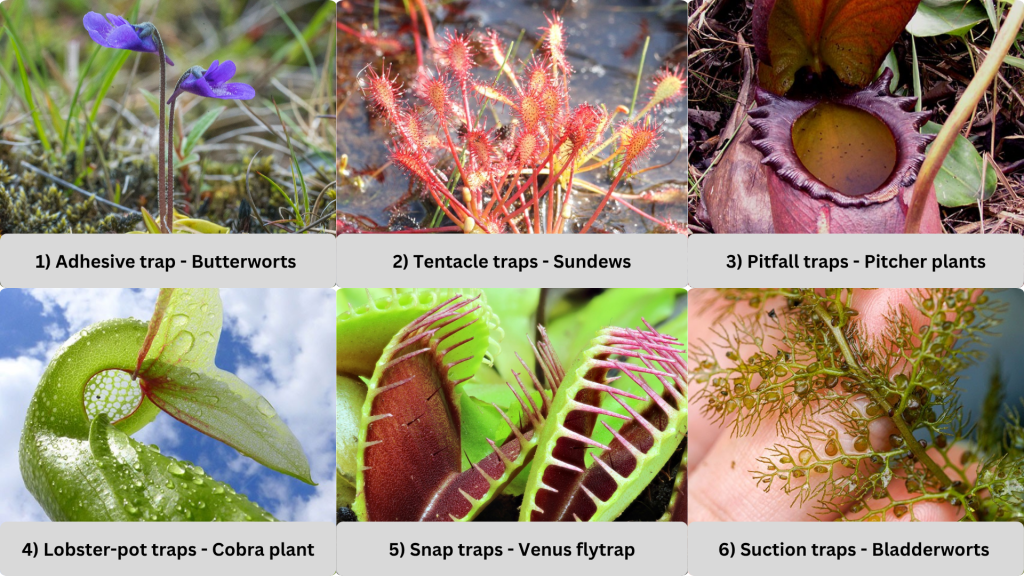
Being a carnivorous plant is not easy. Building and maintaining traps is energetically expensive, requiring extra resources to modify its leaves. Digesting prey, pumping water, and electrical signalling add to the plant’s carbon costs. However, these also come with many benefits, with capturing essential nutrients to boost growth. Carnivory is a high-risk, high-reward strategy.
Five different plant lineages have developed trapping systems independently. This is a classic example of convergent evolution, that is, the independent evolution of similar features in species of different lineages. The driving force for this could be the poor nutrient habitats of these plant species, favouring carnivory evolution as a way to supplement their nutrition.
Carnivorous plants may look harmless, but can be clever hunters. Their unique traps and digestive strategies evolved to survive nutrient-poor habitats, and the repeated evolution of similar solutions highlights the benefits of this strategy. These extraordinary plants reveal just how inventive and surprising nature can be in terms of evolutionary mechanisms.
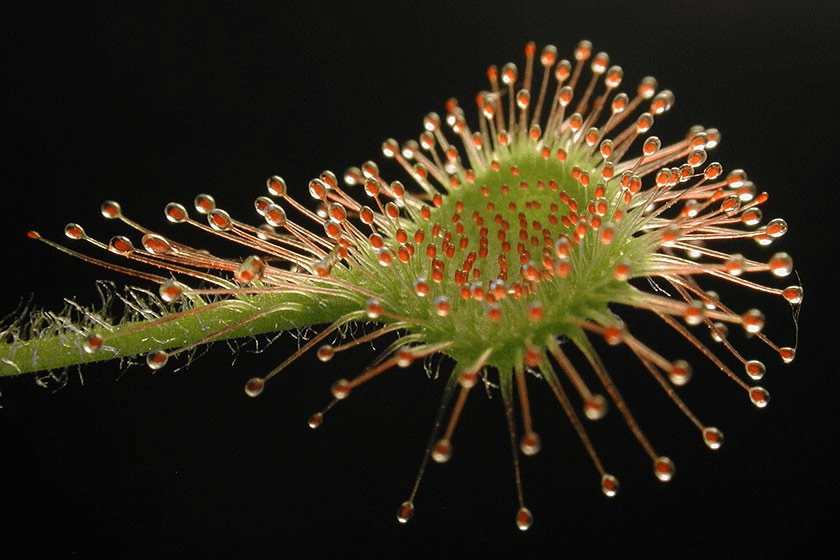
opens in a new window, licensed under CC BY-SA 3.0
References:
- https://gardenprofessors.com/carnivorous-plants/
- https://www.ipcc.ie/a-to-z-peatlands/peatland-species/carnivorous-plants-killers-in-the-bo g/
- https://www.kew.org/read-and-watch/carnivorous-plants
- https://www.nhm.ac.uk/discover/carnivorous-plants-meat-eaters-of-the-plant-world.html
- https://www.botany.one/the-cost-benefit-model-for-botanical-carnivory-review/
- https://www.smithsonianmag.com/science-nature/how-carnivorous-plants-evolved-180979G97/
 NeAr Science Magazine
Leave a comment