
By Emma Murray
In science, revolutions rarely come with applause. More often than not, they come with disbelief, skepticism and ignorance, all brushed with a tinge of professional jealousy. What begins as plain data can quickly become a controversy, especially if that data threatens the foundations of an entire discipline.
A crystal is defined as a homogenous solid formed by naturally occurring inorganic processes,
creating an ordered crystal structure with a clear chemical composition. Crystals imply order and
symmetry. Atoms arrange themselves in neat repeating patterns, extending uniformly in all directions,
like a wallpaper covering an infinite wall. The smallest repeating unit, called the unit cell, dictates the
structure of the crystal. According to the preconceived rules of crystallography, only certain
symmetries were possible. Two-fold, three-fold, four-fold, six-fold symmetries were all perfectly
expected. Five-fold symmetry? Impossible. A pentagon repeats, and it leaves gaps. Therefore,
five-fold symmetry could not be a characteristic of crystals. However, along came Dan Shechtman.
In 1982, while examining an aluminium manganese alloy under an electron microscope at the now
National Institute of Standards and Technology in Maryland, Shechtman observed something thought
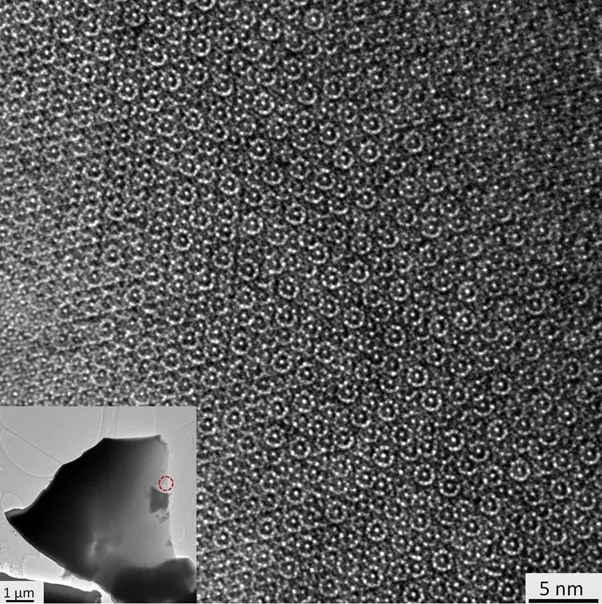
to be impossible (Mihai, 2022). Staring back at him was a diffraction pattern showing light spots
arranged in a pattern with fivefold symmetry. In crystallography, the light spots equate to atomic
order. Five-fold atomic order equated to disbelief.

The simplest explanation was experimental error. Perhaps the instrument was faulty. Perhaps the
sample was twinned. Perhaps Shechtman misunderstood what he was seeing. Yet with repeated
measurements, the same result remained. The data was not cooperating with established theory.
When Shechtman published his findings 2 years later, he was ostracised. He became a joke among his
peers, even being asked to leave his research group. Most famously, double Nobel laureate Linus
Pauling dismissed the discovery, stating, “There is no such thing as quasicrystals, only quasi-scientists”(Mihai, 2022). For years Shechtman stood alone, defending results that contradicted years of scientific understanding. However, as Shechtman remained undeterred, confident in his findings, the evidence accumulated. Various other laboratories began to reproduce similar results. The impossible refused to disappear.
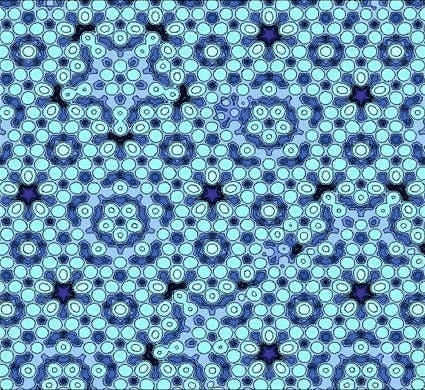
Shechtman had discovered a new state of ordered matter, the quasicrystal. Unlike traditional crystals,
which exhibit repetitive and periodic arrangements of atoms or molecules, quasicrystals possess an
ordered yet non-repetitive structure (Rodriguez-Blanco, 2025). They display long-range order without
translational periodicity. Imagine a tiled floor. In a conventional crystal, the pattern repeats perfectly
at regular intervals. However, in a quasicrystal, the pattern never perfectly repeats, yet it is not
random, nor does it leave gaps. It follows strict mathematical rules, resembling complex tiling
patterns such as Penrose tiling. The result is order without repetition, which is the subtle distinction
that makes these quasicrystals extraordinary.
While initially quasicrystals were curiosities confined to the laboratory, they soon obtained practical
everyday applications rooted in their unusual physical properties. Many quasicrystalline alloys exhibit attributes of reduced friction, heightened hardness, and limited surface reactivity. These properties led
to their use in non-stick cookware coatings. More advanced applications include steel that has been
fortified by tiny quasicrystal particles being integrated into acupuncture needles, surgical instruments,
dental tools and razor blades, enhancing durability and performance (Rodriguez-Blanco, 2025). What
began as an anomaly has evolved into an asset for materials science.
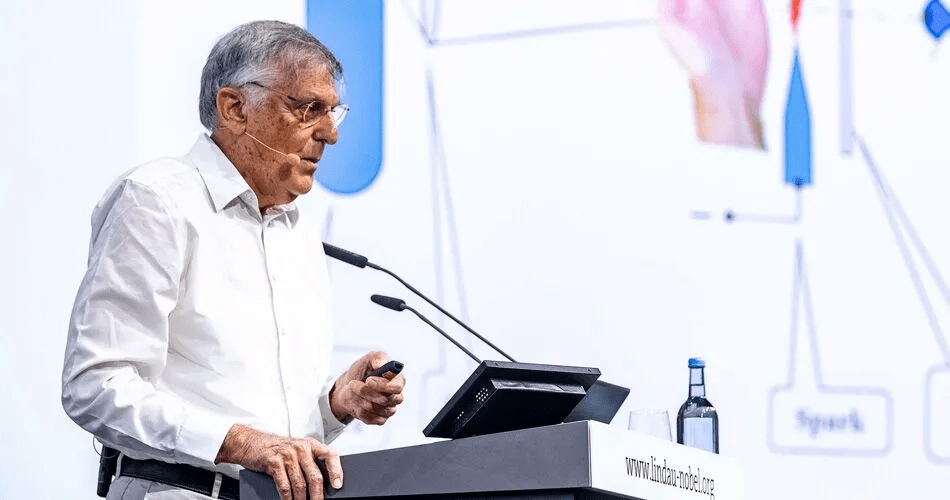
In 2011, nearly three decades after his initial discovery, Shechtman was awarded the Nobel prize in
chemistry for his discovery of quasicrystals. The man who cried crystal was an outsider no more.
Quasicrystals are more than a scientific discovery, they’re also a reminder that science advances not
only through data but intellectual bravery. Dan Shechtman saw a diffraction pattern and trusted his
observations over preconstructed scientific rules. In doing so, he reshaped crystallography and
expanded our understanding of order in crystals. Revolutions don’t begin with a standing ovation,
rather with someone saying, “The textbook is wrong”.
References:
Mihai, A. (2022). The Quasicrystal Debate. [online] Lindau Nobel Laureate Meetings. Available at:
https://www.lindau-nobel.org/blog-adversity-quasicrystals-and-a-nobel-the-forbidden-fivefold symmetry-that-was/
Rodriguez-Blanco, J.D. (2025). Lecture 8: Degrees of Order. GLU33004: The Crystal World. Trinity
College Dublin.
 NeAr Science Magazine
Leave a comment