
By Inés Martínez Marchán
The formation of neutron stars
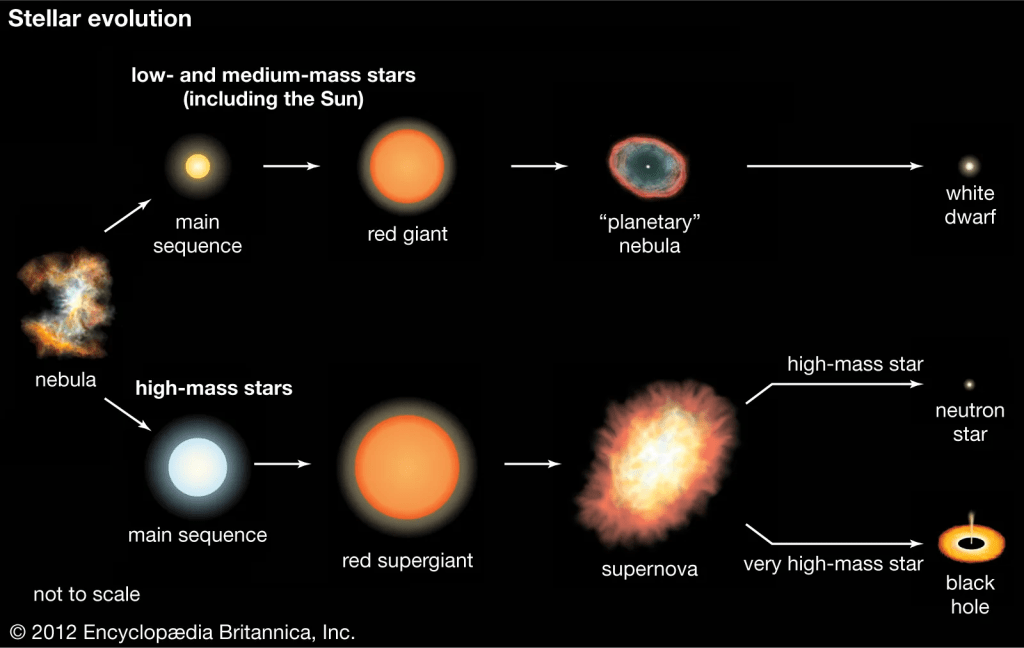
The fate of a star is ultimately dependent on its mass right after its initial formation. Stars with an initial mass greater than about eight times that of the current mass of the Sun are considered massive stars and hold the capacity to form neutron stars after their death. The death of a massive star begins when its core depletes its hydrogen, disturbing the vital balance between gravity and the outward pressure from ongoing thermonuclear fusion, leading to its collapse.
The collapse of the core leads to an increase in temperature of the plasma shell surrounding it, enabling hydrogen fusion, which causes the outer layers to expand due to the extra heat generated. The star’s increasing size dissipates its surface energy, allowing cooling of the surface and giving the characteristic red colour of a red supergiant. [1]
The core of the red supergiant, now devoid of hydrogen, begins fusing helium into carbon, then successively heavier elements over shorter and shorter timescales, eventually stopping once iron is formed. Once the core reaches the phase of iron formation, energy starts being consumed in fusion because iron is the most tightly bound nucleus, so fusing anything heavier no longer has a net release of energy. This causes the star to lose its support against gravity and rapidly collapse.[2] This collapse blasts the outer layers outward, reaching a diameter of several light-years and a brightness that can be even higher than that of its host galaxy. [3]
During the core collapse, most protons and electrons are converted into neutrons. If the mass of the core obeys the Tolman–Oppenheimer–Volkoff limit, where it is less than three times the mass of our sun before collapse, the neutrons can prevent further collapse into a black hole, leaving behind what is known as a neutron star. Neutron stars are some of the densest objects ever recorded, having roughly the same mass as the sun, but compressed down to the size of a city. Neutron stars can be difficult to detect due to their non-radiative nature. Nonetheless, under certain conditions, they can be observed at the centre of supernovae remnants by their X-ray emissions.
Characteristics and classes
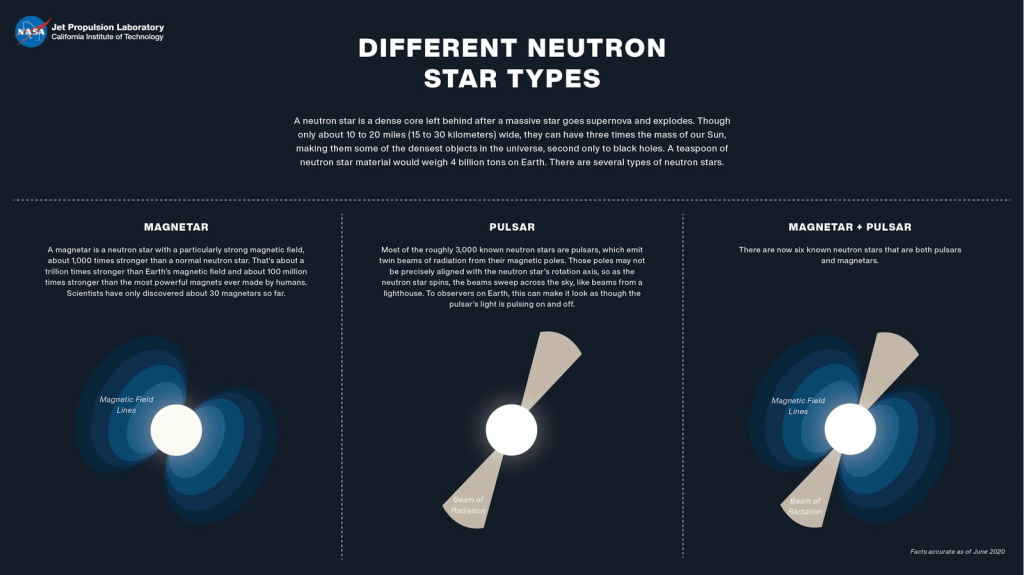
A key characteristic of neutron stars is their extreme magnetic fields, caused by the concentration of magnetic flux into a smaller area, and rapid rotational speed due to magnetic momentum conservation. [4]
There are two main classes of neutron stars: pulsars and magnetars. The most commonly observed class are pulsars, rotating neutron stars that exhibit periodic pulses of radio wave radiation at very short regular intervals. The magnetic poles observed due to the strong magnetic field of the neutron star funnel jets of particles out of the star, producing powerful light beams that are swept around with the star’s rotation due to the disalignment between the magnetic field and the spin axis. Behaving like a lighthouse, we are only able to observe the beam of light once it sweeps over the earth and crosses our line-of-sight, appearing to us as if the pulsars are turning on and off.
The other class of neutron stars are magnetars, which have magnetic fields up to a thousand times stronger than those of pulsars. The huge magnetic fields observed in magnetars allow the release of a vast amount of electromagnetic radiation in response to movements in the crust. This is because the star’s crust and its magnetic field are locked together and dependent on one another. One magnetar, SGR 1806-20, in a burst of a duration of one tenth of a second, released more energy than the sun has emitted in the last ten thousand years. [5]
Their role in the universe
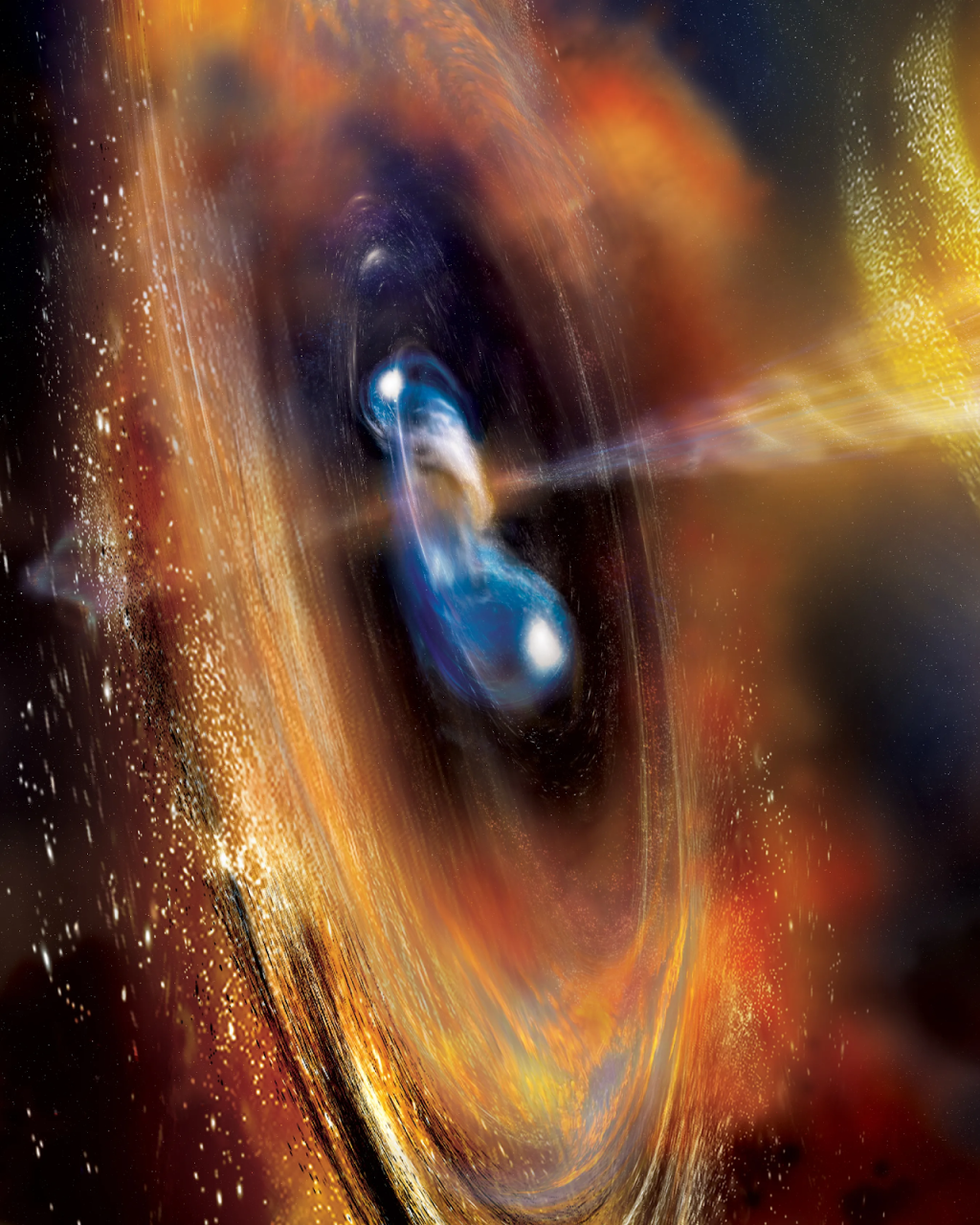
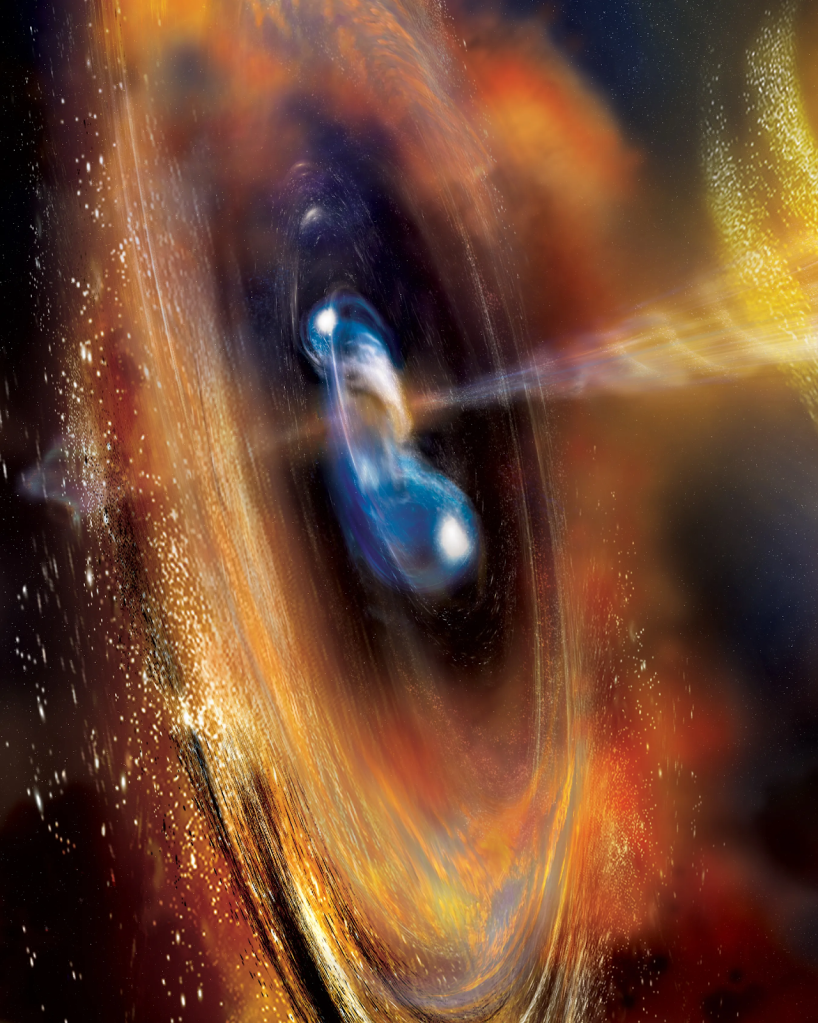
The role of neutron star collisions in the universe is of utmost importance. When neutron stars collide, they undergo nucleosynthesis, forming heavier elements than iron, such as gold, platinum, and uranium. This is caused by the intense compression and heat releasing a short gamma-ray burst, one of the universe’s most energetic phenomena, while neutron-rich matter is ejected at high speeds. Furthermore, this phenomenon also emits gravitational waves, rippling spacetime itself, which can be detected by observatories like LIGO and Virgo. The merger often leaves behind a more massive neutron star or collapses into a black hole, depending on the combined mass, marking both a violent end and a cosmic contribution to the chemical evolution of galaxies. [6]
Therefore, the reason you can read this magazine or put on some jewellery is due to heavy elements formation in nucleosynthesis, a process most likely caused by the collision of two neutron stars, showing that even the most mundane objects can be linked back to star dust!
References:
Image: https://www.nasa.gov/image-article/neutron-stars-collide/
[1]: https://esahubble.org/wordbank/red-giant/
[2]: https://imagine.gsfc.nasa.gov/observatories/history/suzaku_10yr/snr.html
[3]: https://esahubble.org/wordbank/supernova/
[4]: https://arxiv.org/abs/0802.2227
[5]: https://imagine.gsfc.nasa.gov/science/objects/neutron_stars1.html
[6]: https://news.mit.edu/2021/neutron-star-collisions-goldmine-heavy-elements-1025
 NeAr Science Magazine
Leave a comment