
By Nathalie Al Ja’Afrehová
Why can large animals like elephants live for decades, while smaller animals like mice barely last a few years? At first glance, it seems fairly intuitive. Smaller animals are more vulnerable to environmental factors or predators in the wild, while animals like elephants don’t necessarily have to worry too much about these factors. However, if these external pressures were to be removed, elephants would still outlive mice under ideal laboratory conditions. The fundamental secret of the elephant’s longevity lies in its metabolism.
When an organism respires, it catabolises (breaks down) molecules of food and oxygen to create ATP, which is used as energy used to power the organism. Early researchers found that animals with fast heart rates (or faster metabolisms) tended to have much shorter lifespans (Rubner, 1908). While a mouse’s heart beats at 600 bpm and an elephant’s at 30bpm, they both accumulate approximately one billion heartbeats per lifetime. This led to the creation of the ‘Rate of Living theory’, the idea that every organism has a fixed amount of energy to use over its lifetime. This proposed that the relationship between metabolism and lifespan is inversely proportional, i.e., slower metabolisms lead to longer lifespans. This theory then gained more traction with the scaling discovery of Kleiber’s Law, which found that an organism’s basal metabolism could be predicted with the formula of the animal’s bodyweight to the power of three quarters (bodyweight3/4) (Kleiber, 1932). Meaning that larger animals tend to be more energy efficient.
What is the issue with this? Well, it’s like “burning the candle at both ends” in terms of biological ageing. Rapid wear leads to rapid tear. When we burn oxygen to make energy, we create unstable byproducts called reactive oxygen species (ROS), or free radicals. ROS are instrumental in several biological processes like cell signalling and the immune response. Unfortunately, too many of them can lead to oxidative stress causing the damage of DNA, proteins, and cell membranes, leading to ageing. The faster your metabolism, the more free radicals you create, the faster you age.
This relationship isn’t completely straightforward, as recent studies suggest that mitochondria can ‘uncouple’ energy through special channel proteins called uncoupling proteins (UCPs). When these UCPs are active, mitochondria become less efficient, burning more oxygen to make the same energy. This may seem counterproductive, however this generates fewer free radicals (Erlanson-Albertsson, 2002). Thus, in some cases, mitochondrial inefficiency may correspond to less cellular ageing.
However, nature is never this simple and there are many exceptions to this rule. Take the naked mole-rat (Heterocephalus glaber) for instance. This lovable, wrinkly, burrowing rodent weighs about the same as a mouse, but can live over 30 years which is at least ten times longer than the average mouse. Naked mole-rats display extremely low metabolisms for their size, an evolutionary adaptation for their low oxygen, underground tunnel lives. Their cells also demonstrate an unusual resistance to ROS. But these rodents aren’t the only exceptions to the rule. Birds, bats, and certain species of fish and turtles also extend their lifespans far beyond that of which their sizes predict, perhaps indicating that Kleiber’s Law is more suited for intraspecific or intragenus studies.
Ultimately, the relationship between body size, metabolic rate and lifespan depicts the fundamental tradeoffs of biological design. Smaller animals display higher mass-specific metabolic rates, increased production of ROS and a decreased efficiency of cellular repair. In contrast, larger animals have lower mass-specific metabolic rates, decreased ROS production and hence less oxidative stress. From an evolutionary perspective, this tradeoff makes perfect sense, since an elephant takes a longer amount of time to mature and reproduce, than a mouse. Mice have evolved to mature quicker in order to optimize reproductive success, due to extrinsic mortality factors (predation, starvation, environmental factors). Therefore metabolic rates are a delicate balance between energy use, molecular maintenance, and evolutionary strategy. These define the diversity of life-history strategies observed across the animal kingdom, a dynamic equilibrium that has sustained the continuity of life through time.
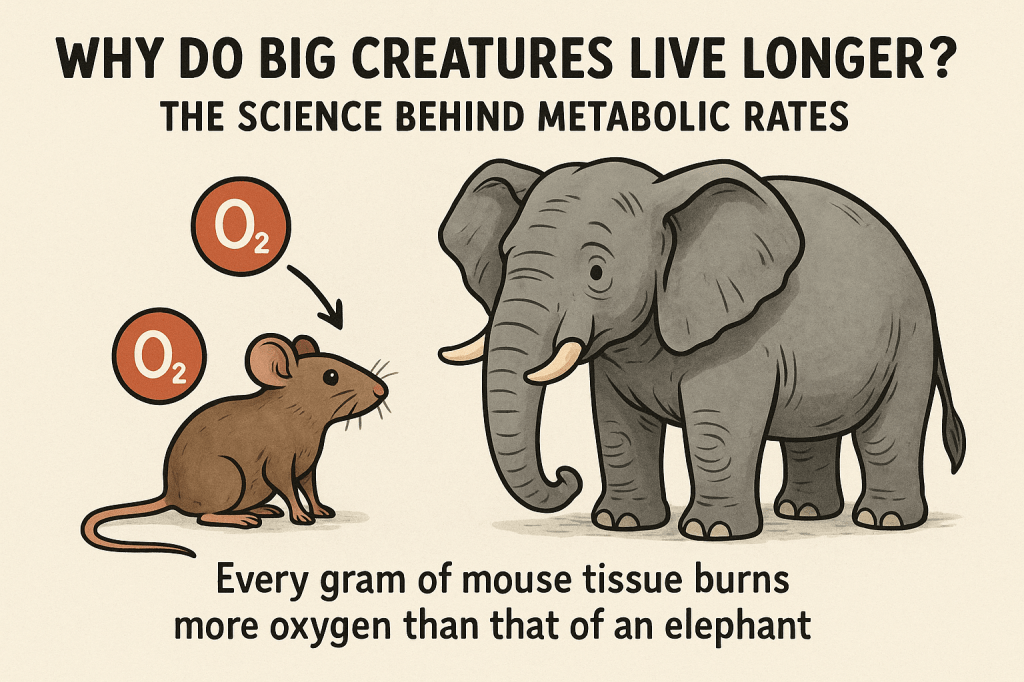
Image created with AI
 NeAr Science Magazine
Leave a comment