
By Darragh McCann
Nearly two years ago, on the first of July 2023, a SpaceX Falcon 9 launched from Cape Canaveral, carrying with it a telescope destined to uncover our universe’s deepest, darkest secrets. This was the beginning of the European Space Agency’s (ESA) Euclid mission, designed to observe and map the composition and evolution of the Dark Universe. This means observing billions of galaxies at distances of up to ten billion light-years. And now that it is sitting in an orbit one and a half million kilometres from Earth, it has begun sending back the results of its observations.
What is the Dark Universe?
The “Dark Universe” is a catch-all term used to encompass both dark energy and dark matter. But what exactly are they? Simply put – dark energy is a form of energy whose effects we can observe, but whose origin is unknown, and dark matter refers to gravitational effects which we can observe, but whose source is also unknown. The reason why this is so important is that the dark universe actually comprises 95% of all that exists.
Dark Energy:
In 1923, American astronomer Edwin Hubble realised that not all of the fuzzy clouds of light in the night sky were nebulae – some were distant galaxies. Hubble devised a way to not only measure the distances to these galaxies, but also a way to use the Doppler effect to determine that they were moving even further away.
“In 1923, Edwin Hubble discovered that some light clouds in the sky were actually distant galaxies. He developed methods to measure their distances and used the Doppler effect to show that these galaxies were moving away from us”
The Doppler effect is the idea that when the source of a wave is moving towards an observer, the speed of the wave and its source add up, increasing the frequency of the waves. Likewise, when the source is moving away, the frequency decreases. Imagine a passing car. As it gets closer, the sound of its engine appears to get higher in pitch until it passes, and the sound abruptly changes to become lower in pitch. This same principle can be applied to the light waves we receive from a galaxy. If the light from a galaxy is bluer (higher frequency) in colour, it is moving towards us, but if it is redder (lower frequency) it must be moving away. Hubble found that the vast majority of galaxies emitted red-shifted light, meaning they were moving away from us, and that the further away a galaxy was, the faster it was moving away from us. Based on this, he concluded that the universe must be expanding uniformly.
“The Doppler effect explains how waves change frequency based on the motion of their source. When something moves toward you, wave frequency increases; when it moves away, frequency decreases—like the pitch change of a passing car. This same principle can be applied to the light waves we receive from a galaxy. If the light from a galaxy is bluer (higher frequency) in colour, it is moving towards us, but if it is redder (lower frequency) it must be moving away. Hubble observed that most galaxies show red-shift, with more distant ones moving away faster, leading to his conclusion that the universe is expanding uniformly.”
This principle, now known as Hubble’s law, allowed him to essentially rewind the motion of the galaxies to determine how long ago the distance between us and the rest of the universe was zero.
Initially it was suspected that the universe was old enough that its expansion should be slowing, but the more galaxies we observed, the more we realised that the expansion of the universe was actually speeding up, not slowing down. But what is causing the expansion to speed up? That’s the problem; we don’t know. So, for now, we have dubbed this mysterious force expanding the universe as “dark energy” until its source or sources are discovered, and a more appropriate name can be given.
Dark Matter:
Further observation of these distant galaxies, first observed by Hubble, led to their rotational speeds being measured. Using some simple physics, this could then be used to determine the mass of the galaxy. As well as this, the brightness of a galaxy can be used to estimate the total mass of stars in it, which was thought to give a good approximation of the total mass of the galaxy. However, the masses calculated using these two different methods did not match. The galactic rotation indicated the galaxies were significantly more massive than their brightnesses suggested, which only accounted for 5% of the mass indicated by their rotation. This means the universe must contain 85% matter which does not interact with light – dark matter.
Combining this theory of dark matter with the theory of dark energy tells us that the universe is composed of 5% ordinary matter, 25% dark matter, and 70% dark energy, which gives us the aforementioned figure that the dark universe accounts for 95% of the universe.
“Observations of galaxy rotation revealed they were spinning faster than expected based on their visible mass. However, the masses calculated using these two different methods did not match. While brightness estimated the mass from stars, rotation suggested galaxies were much more massive—only 5% of this mass was visible. This led to the idea of dark matter, which doesn’t interact with light. Combined with dark energy, it’s now believed that the universe is made of 5% ordinary matter, 25% dark matter, and 70% dark energy—meaning 95% of the universe is “dark.””
Observing the Unobservable:
While dark matter and energy likely cannot be observed directly due to their nature, their effects can be. This is what the Euclid telescope aims to do.
“The Euclid telescope aims to observe the effects of dark matter and energy.”
Over the course of the next six years, it will observe billions of galaxies up to ten billion light-years away. It can take high-quality images in the visible and infrared spectra across a wide field of view in one sitting. By measuring the distances to these galaxies and recording how they move over time, Euclid aims to create the largest ever 3D map of our universe.
In the same way Hubble was able to use his observations to rewind galactic motion and determine the age of the universe, Euclid’s observations will allow researchers to obtain even more detailed data on the movement of galaxies, and thus more detailed measurements of the age of the universe and the effects of dark energy can be made.
“Like Hubble before, Euclid’s observations will help scientists study galaxy movement in greater detail, leading to more precise measurements of the universe’s age and the influence of dark energy.”
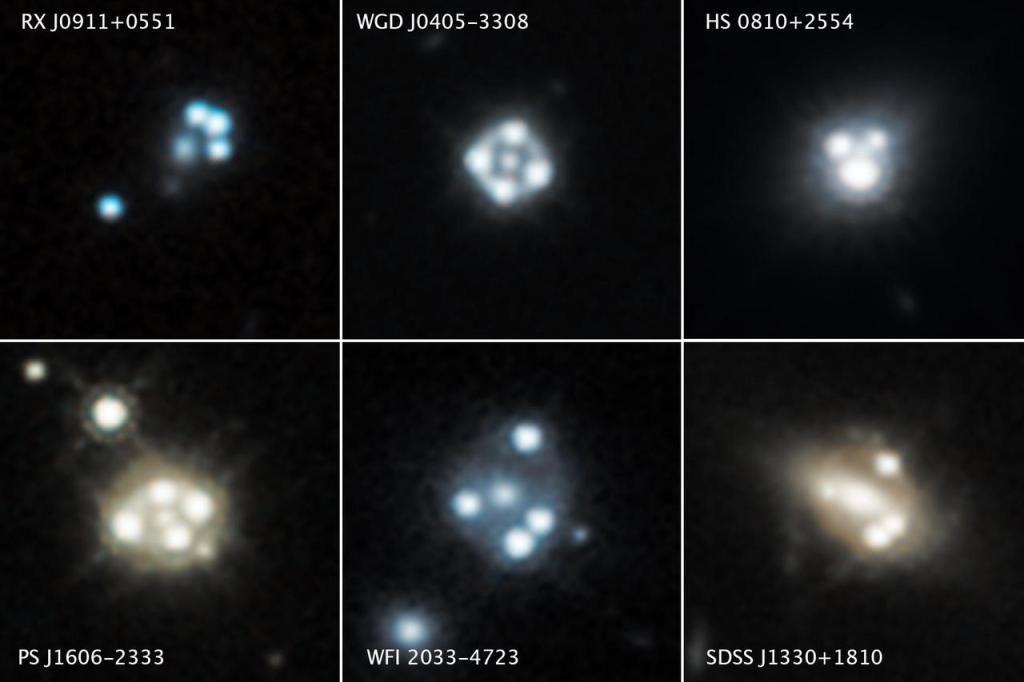
Euclid’s 600-megapixel camera will also allow scientists to more closely observe the effects of dark matter on the rotation of galaxies and on gravitational lensing. This will further our understanding of the distribution of dark matter in the universe.
The Results So Far:
On the nineteenth of March, the ESA publicly released all of the data Euclid had collected so far. This included observations of twenty-six million galaxies, making it one of the largest galactic classification surveys yet. However, this number only represents 0.4% of the total number of galaxies Euclid will image over the course of its six-year mission. In a press release, the ESA’s Director of Science, Professor Carole Mundell said: “With the release of the first data from Euclid’s survey, we are unlocking a treasure trove of information for scientists to dive into and tackle some of the most intriguing questions in modern science. With this, ESA is delivering on its commitment to enable scientific progress for generations to come.”
Though this first release contains no major breakthroughs, in the coming years, Euclid will repeat these observations several times, capturing more galaxies at different distances. Eventually, at the end of its mission, Euclid will have successfully created a highly detailed 3D map of a third of the night sky, and hopefully will allow us to better understand the distribution of dark matter in the universe. This could have massive implications, leading to more accurate estimates of the universe’s age, and a deeper understanding of the mechanisms behind dark matter and dark energy. However, we will have to wait for Euclid to complete its full mission before these implications can be fully understood.
All of this data, including an interactive sky map, can be accessed via the ESA’s Astronomy Science Archives at https://www.cosmos.esa.int/web/esdc.
 NeAr Science Magazine
Leave a comment