
By Anna Wlizlo
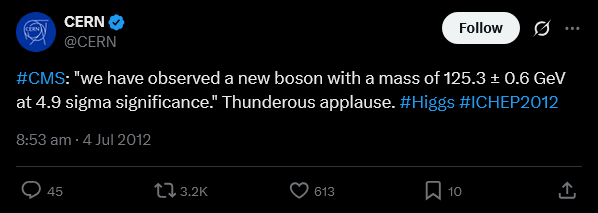
One morning, just outside Geneva, Switzerland, a group of scientists gathered, awaiting the presentation of the first results from the newly built Large Hadron Collider. The suspense was palpable, the atmosphere thick with the anticipation of a breakthrough. Scientists from all over the world followed the event both in person and online. Joe Incandela and Fabiola Gianotti, spokespeople for the European Organisation for Nuclear Research (CERN), gave long presentations, culminating in one simple phrase: ‘we have it’. The crowd erupted and tears of joy were shed. That morning, CERN had officially confirmed the discovery of the Higgs boson and spread the news of their success via social media.
A Few Key Concepts:
⚛ Wave-particle duality, a key idea in quantum physics, describes how particles like electrons and photons can behave as both waves and particles.
⚛ Bosons are a category of particle, which include a subcategory called gauge bosons. These are force-carrying particles, such as photons (electromagnetic force), gluons (strong force), and W and Z bosons (weak force).
⚛ Gauge bosons are elementary particles, unlike mesons, which are composite hadrons, composed of quarks. In the Standard Model, gauge bosons facilitate particle interactions by undergoing exchanges, which can be observed as forces.
⚛ Gauge symmetry, which is the idea that certain changes can be made to a quantum field without affecting the laws of physics.
From One Theory to Another:
Quantum field theory, the foundation of the Standard Model, had already successfully described the electromagnetic force through quantum electrodynamics. However, applying the same approach to the weak interaction posed a serious challenge. The theory’s gauge symmetry required all force carriers to be massless – yet W and Z bosons must have mass to explain the short range of the weak force. This contradiction led physicists to search for a new mechanism that could explain how these particles gain mass without breaking gauge symmetry.
The Higgs Mechanism:
This issue was addressed in 1964 with the proposal of the Higgs mechanism by two groups: one led by Peter Higgs, and the other by Robert Brout and François Englert. They hypothesised the existence of a new quantum field called the Higgs field, which could spontaneously break gauge symmetry and thus give particles mass. Spontaneous symmetry breaking occurs when a system governed by symmetric laws settles into an asymmetric state. A common analogy for this is to imagine a pencil balanced on its tip at the centre of a level table. While this scenario is perfectly symmetrical in theory, in reality, the pencil will inevitably fall in a random direction, spontaneously breaking the symmetry.
The Proposition of a New Particle:
For the Higgs mechanism to work, the Higgs field must have a corresponding particle – the Higgs boson. Unfortunately, proving the existence of this particle experimentally would turn out to be incredibly challenging. According to the theory, the Higgs boson would be extremely massive (approximately 130 times the mass of a proton) and would have an extremely short half-life (~10-22 seconds). As a result, the Higgs boson could not be found in nature and could only be detected if it were produced artificially in high-energy particle collisions. However, the technology required to carry out such an experiment was not available at the time, meaning the Higgs mechanism would have to remain theoretical for nearly half a century before it could be tested.
Searching for the Higgs Boson:
To detect the Higgs boson, scientists at CERN needed a way to produce high enough energy collisions to create one. However, even at the required energies, the creation of a Higgs boson is still highly improbable, with only one in a billion collisions ending in particle production. Overcoming these challenges required the construction of the Large Hadron Collider (LHC), a 27-kilometer ring of superconducting magnets, which accelerate protons, before colliding them at energies of up to 13.6 TeV. Operational since 2008, the LHC houses two main detectors, the largest particle detectors in the world: ATLAS (A Toroidal LHC ApparatuS) and CMS (Compact Muon Solenoid). ATLAS is the larger of the two and uses toroidal magnets, which bend the paths of charged particles, allowing for their properties to be measured, while CMS is more compact, with a powerful 4 Tesla superconducting solenoid magnet detector, which allows for more precise measurements. The use of two detectors with different designs allows the LHC to be more versatile and allows measurements to be compared between detectors.
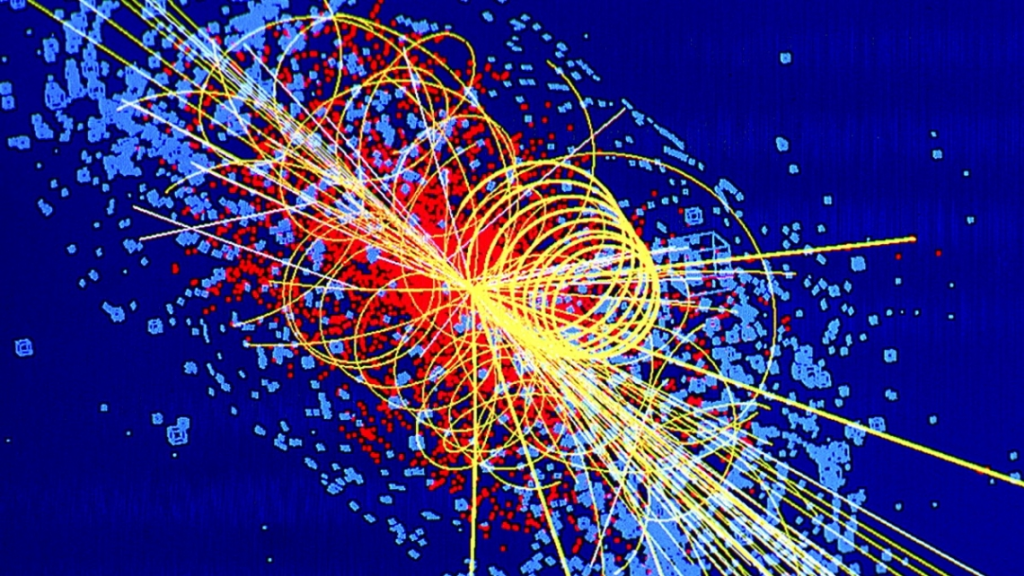
To filter out the production of unwanted particles from the billions of collisions which fail to produce a Higgs boson, researchers first needed to understand what the production of a Higgs boson would look like to a detector. The Higgs boson was predicted to have a spin of 0, no electric charge, and a half-life on the order of 10-22 seconds. As the Higgs is so short-lived, it cannot be detected directly, however, the products of its decay can be. It was predicted that it would decay into either a pair of top quarks or a pair of W bosons, which would then decay further into other particles, such as Z bosons and photons. By identifying these decay products at the correct energies, researchers could infer that a Higgs boson must have been produced.
After several months of collecting petabytes of data, scientists were able to confirm the detection of the Higgs decay chain, meaning the boson had been successfully produced. The reason so much data needed to be collected was because of both the rarity of Higgs boson production, and the burden of proof required for the discovery of new particles. Particle physicists have agreed upon five sigma as being the statistical significance required to confirm the discovery of a new particle. Put simply, this statistical significance corresponds to a 99.99994% certainty that the results of the experiment are accurate. This means the probability that the results were incorrect was as low as rolling a die and getting the same result eight times in a row.
Impacts of its Discovery:
It’s clear the discovery of the Higgs boson had a huge impact on particle physics – but how is it relevant in everyday life? So many technological improvements were needed before the Higgs boson could be produced, and as a result, many new technologies were developed in pursuit of its discovery. Some of the developments that came about in the process of CERN’s work towards the discovery of the Higgs boson include improving air pollution monitoring systems, protection of cultural heritage, cancer treatments, touchscreen technology, and most impactful of all, the World Wide Web. The work of CERN has not only furthered our understanding of the natural world, but also indirectly improved our daily lives.
Now that you understand the Higgs boson and the work that went into its discovery, you can hopefully better understand the astonishment of the scientists when its existence was finally confirmed after half a century. And hopefully now after reading this you might be a little closer to appreciating the world of particle physics. Welcome aboard, Higgs boson enthusiasts!
 NeAr Science Magazine
Leave a comment